Her Dad Raheem Mustafa once told me Phylicia Barnes kept her head in the skies. Redfelecting upon the memories of when he used to take her to the airport to watch airplanes take off, and like any child still full of wonder, she looked upward toward possibility, toward hope, toward life. Her mother Janice-Sallis-Mustafa, shattered by fear and grief, said words that still echo all these years later: “My daughter is a flower.” That’s exactly who Phylicia was. A flower. Delicate, beautiful, alive with promise. She should have been protected but instead, she was taken, discarded, and ultimately found in the river. Now, fifteen years later, the silence surrounding what happened to this child remains one of the most disturbing indictments of Baltimore, and the Community’s failure to protect her and to deliver truth.
Phylicia Barnes will not be just another headline. She was not be a statistic. She was not just another Black child America allowed to slip from the front page and into the shadows. She was a 16-year-old honor student from Monroe, North Carolina, visiting family in Baltimore during Christmas break, a bright young girl with a future in front of her. Then she vanished on December 28, 2010, and months later, on April 20, 2011, her nude body was found floating near the Conowingo Dam in the Susquehanna River. Her death was later ruled a homicide. Fifteen years have now passed, and still this case sits like an open wound.
I called her flower in the river because that is how this case has always felt to me. A beautiful child discarded, carried away by cold water, while the world moved on too quickly and too comfortably. However, I have not moved on, and I will not (a promise I made to her family). The people who were around Phylicia in those final hours have had nearly a decade and a half to continue living their lives, building routines, creating distance, and convincing themselves that silence is something other than cowardice. It’s not. Silence in a case like this is complicity of the spirit.
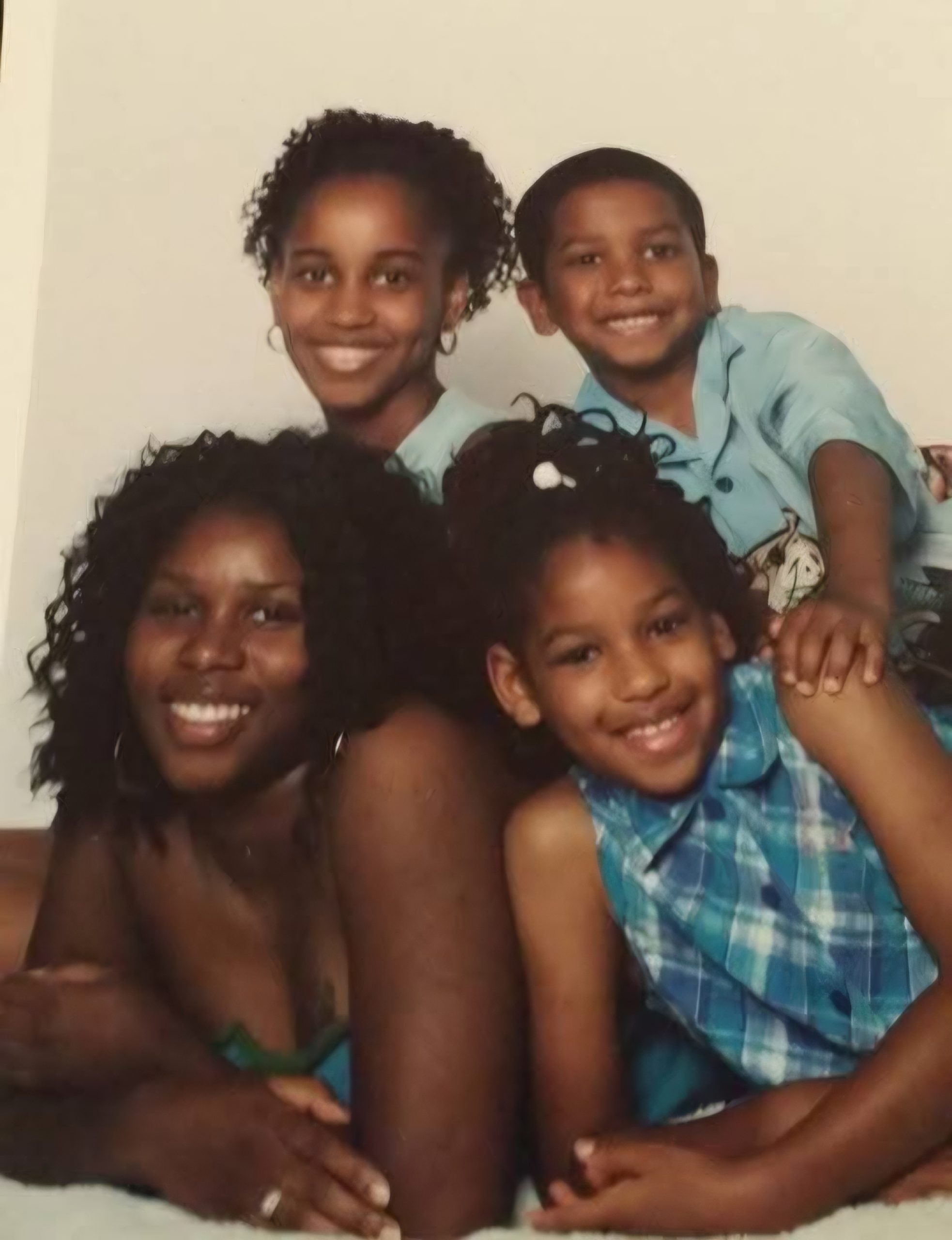
A young Phylicia Simone Barnes pictured with all of her maternal siblings (image coortesy of Shauntel Sallis Ashley).
The known facts have never stopped being disturbing. Phylicia disappeared while staying with relatives in Baltimore. Police said she was last seen on December 28, 2010. After she vanished, there was no activity on her phone, no use of her credit cards, and no Facebook updates. Authorities publicly said they were “enormously concerned.” A large search effort followed. A reward grew, billboards went up, and volunteers searched. Then in April 2011, even after a major search of Patapsco Valley State Park, police admitted they were essentially back at square one. Just days later, her body was discovered near the Conowingo Dam, about 45 miles from where she disappeared in Northwest Baltimore.
And then came the ugly legal maze that so often deepens grief instead of relieving it. Michael Johnson, the ex-boyfriend of Phylicia’s half-sister (Deena Barnes, who Phylicia had been staying with while in Baltimore) and the man authorities said was the last person to see her alive, was charged in 2012. Prosecutors alleged that Michael Johnson asphyxiated Phylicia Barnes inside her sister’s apartment, put her body into a 35-gallon plastic tub, carried it out, and ultimately disposed of her in the river. They also presented testimony that he had made sexual advances toward her after letting her drink alcohol.
He was convicted of second-degree murder in 2013. That conviction was later thrown out, the case unraveled through repeated court battles, and by March 30, 2018, Johnson was subsequently acquitted after a third trial. Whatever anyone believes happened, the public record is clear on this much. Phylicia Barnes was killed, and the system failed to deliver a final, lasting measure of accountability and justice.
An honors kid just visiting family and suddenly taken from this earth. Her body was found naked in a river. Somebody knows more than they have said. Memory fades, loyalties shift, guilt grows heavier with age, and consciences do sometimes crack. Cases are not only solved by science. Sometimes they are solved because time finally breaks the silence that fear protected.
So let this be another reminder, another public record, another refusal to let Phylicia Simone Barnes be buried under the comfort of other people’s forgetting. If you were there, if you heard something, if you saw something, if you know what happened inside that apartment, after that apartment, on that day, or in the days that followed, speak up now. Fifteen years is too long to hide behind confusion, friendship, family ties, or old fear. A girl is dead. A family was shattered. The truth is still owed.
Phylicia Simone Barnes deserved better in life. She deserved better in death. She deserves better now than this long, sickening silence. Somebody knows what happened, and we knoow this because one of the females hanging around the apartment tweeted het location (“it’s trapped at the dam, don’t pull the level”) before she was even found. If no one around her had the courage to protect her then, the least they can do now is tell the truth. In her memory, while still seeking justice.
David B. Adams is a journalist, crime writer, and founder of The People's Champion, a platform built on truth, justice, and advocacy for the overlooked. For over a decade, Adams has investigated wrongful convictions, missing and exploited children, homelessness, and the political forces that shape marginalized communities' lives.
What sets his work apart is a refusal to sensationalize. Adams treats crime reporting as human storytelling — pushing past headlines to examine the systemic failures in law enforcement, the courts, and government that so often go unexamined. He's built a reputation among activists and advocates for combining deep research, personal narrative, and unflinching commentary.
The People's Champion began as a personal outlet and has grown into a respected independent voice in crime and justice journalism, read by audiences nationwide who care about accountability and the people too often left out of the story.