It was a case that helped shape my path as a teen kid growing up in Baltimore City. Attending public school in the city was a challenging experience in 1980s Baltimore. That challenge was even more stringent for some kids who had to travel long distances to get to class, like I did. I auditioned and was accepted into a citywide music careers program, and had to catch several buses from the Johnston Square section of East Baltimore to the Mondawmin area in West Baltimore. With the drug epidemic at its peak, crime and violence were a constant concern.
While I never encountered any serious problems commuting during those years, it was a given that a teen kid could be stopped, harassed, or implicated in crimes that occurred throughout the city. It was my senior year, and what happened to three ninth graders at Harlem Park Junior High School was one of the greatest miscarriages of juvenile justice Baltimore has ever seen.
That year was an exciting time for a lot of Baltimore youth, since local basketball stars Reggie Williams and David Wingate were key players at Georgetown University in neighboring Washington, D.C. Every kid in Baltimore wanted a Hoyas jacket. Some kids’ parents could afford the $52 to $75 price tag. For a couple of Baltimore youth, the privilege of owning one came at a far heavier cost. On November 18, 1983, 14-year-old ninth grader DeWitt Duckett was shot and killed inside Harlem Park Junior High School in West Baltimore.
Around 1:15 to 1:25 p.m., Duckett was walking to the cafeteria with two classmates through a hallway, wearing his Georgetown Starter jacket. A man with a small-caliber gun, flanked by two other people, demanded he hand it over. As Duckett was taking it off, the gunman turned the weapon on the other two students, and they ran. While Duckett was running too, the man shot him in the neck. The two people who came with the shooter never touched the jacket and walked off without taking part in the robbery or the killing.
Duckett managed to run upstairs, through the cafeteria, and collapsed in front of the administration office doors before he was rushed to the R Adams Cowley Shock Trauma Center, where he died. It became one of several so-called “clothing murders” that plagued the city in that era — kids killed over sneakers or sportswear. Veteran Baltimore homicide detective Donald Kincaid caught the case, and based largely on a teacher’s tip that three former students had been seen near the school beforehand, three ninth graders became suspects in the killing.
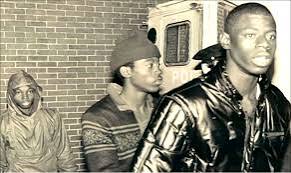
On Thanksgiving Day that year, Baltimore homicide detectives arrested three 16-year-old boys from the Harlem Park neighborhood: Alfred Chestnut, Andrew Stewart, and Ransom Watkins. The city wanted blood, and that pressure to solve the case fast came down from city officials all the way to Kincaid’s desk. That pressure is where this story took its horrible detour.
Kincaid was assigned the case the day of the shooting, and the very next day he went to question Chestnut and Watkins at their homes. It’s never been confirmed whether Kincaid zeroed in on the boys because Chestnut happened to be wearing a Hoyas jacket of his own that day, but for whatever reason, Chestnut and his two friends became the detective’s primary suspects. All three had grown up with DeWitt Duckett. He wasn’t a stranger to them. He was their friend.
Chestnut had a Georgetown Starter jacket of his own, and his mother had bought it for him. She testified at trial that she’d purchased two Starter jackets weeks before the murder, and she had the receipt to prove it. The store clerk who sold them to her backed her up on the stand, even though he admitted he couldn’t swear the exact jacket in evidence was the one he’d sold her. The defense also pointed out that a crime lab exam of Chestnut’s jacket turned up no blood, no hair, no tissue — evidence that should have been there if it had really been torn off a boy who’d just been shot in the neck. Receipt, clerk testimony, clean forensics. Didn’t matter. The jury convicted Chestnut and his co-defendants anyway.
Here’s the part that should make your blood boil: four independent eyewitnesses described an 18-year-old man fleeing the scene before police ever arrived. None of those statements were ever turned over to the defense, even though the law required it under Brady v. Maryland. The trial jury never heard a word of it. Three teenagers were sentenced to life in prison instead. Year after year, there were postponements, denials, and delays that stretched across 36 years.
So that’s what it came down to. At 16 years old, these boys were tied to a murder because they’d been near the school earlier that day and one of them owned a jacket like the victim’s. The local press called them calculating and savage. It was a grotesque characterization of three teenagers who’d gone to school with the boy they were accused of killing.
They said they were innocent for over three decades. Nobody listened.
Alfred Chestnut kept requesting the original investigation file, over and over, for 25 years, before it finally landed in his hands. And it was all there — the statements from eyewitnesses who described a single gunman, the exculpatory statements, the record of witnesses repeatedly failing to pick the three defendants out of photo lineups. All of it buried. All of it known to the people whose job it was to hand it over.
Once Chestnut had those documents, he got them to the Baltimore prosecutor’s office, the case got reexamined, and the truth finally came out. Alfred Chestnut, Andrew Stewart, and Ransom Watkins were exonerated in 2019, after spending 36 years — nearly their entire adult lives — locked up for a killing they didn’t commit. Every one of the four witnesses who testified against them recanted, saying detectives had coached their statements. In 2023, the city paid the price for it: a $48 million settlement, the largest in Baltimore’s history. And the man who actually killed DeWitt Duckett? Never identified. Never charged. He got away with it while three innocent kids did his time.
This isn’t a story about a broken system making an honest mistake. This is a story about grown men — detectives, a prosecutor, an entire machine built to protect this city — who had the truth in their hands in 1983 and buried it because three Black teenagers were an easier answer than doing the actual work. They took witness statements that cleared these boys and made them disappear. They coached children into lying under oath. They watched a mother hand over a receipt and a jury convict her son anyway. And then the city let those boys rot for 36 years while the real killer walked free somewhere in Baltimore, never once made to answer for what he did.
Alfred Chestnut, Andrew Stewart, and Ransom Watkins didn’t get their childhoods back. They didn’t get their twenties or thirties back. They sued Baltimore City Police and settled for $48 million dollars. No settlement check, no matter how large, hands a person back four decades of birthdays, weddings, funerals, and ordinary Tuesdays they should have been free to live. What happened to them wasn’t a glitch in the system. It was the system working exactly the way it was built to work for kids like them — arrest first, ask questions never. And until this city reckons honestly with how many more Chestnuts, Stewarts, and Watkinses are still sitting in cells right now, this story isn’t history. It’s a warning.
Donald Kincaid had also been a detective involved in another wrongful conviction the year prior. In 1982 Wendell Griffin was convicted of murder after police files containing failed eyewitness indentifications and other exculpatory statements were not disclosed to his defense. Kincaid’s record came under fire because he was involved in the investigation of that case also. Griffin also spent decades convicted until those records in his case emerged.
So, when Albert Chestnut finally opened his own hidden file, he wasn’t uncovering an isolated mistake, he was looking at a pattern linked to the same detective. Detective Donald Kincaid never had anything taken from him and went on to retire from the Baltimore City Police. The settlement mony came from the tax paying citizens of Baltimore. The real killer was never captured.
I’m David B. Adams Sr, Journalist and Blogger
The People’s Champion Blog