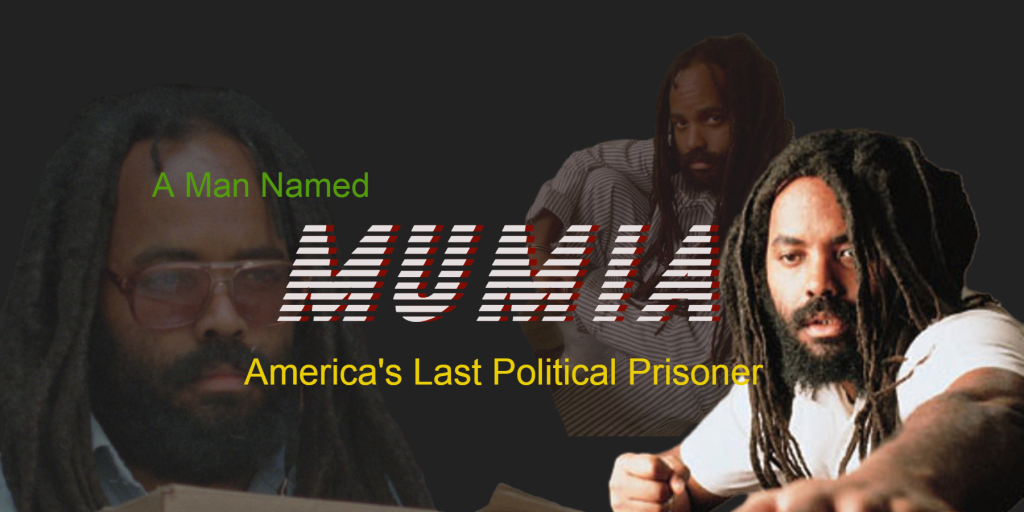
There are those in power within our society who want to feed the public at large information an expect their official version of events to be the gospel. But in the case of Mumia Abu Jamal, to accept the official account of the killing of Philadelphia Police Officer Daniel Faulkner, one must accept a coincidence so extraordinary that, more than four decades later, America is apparently discouraged from examining it more closely.
It begins in the darkness before dawn on December 9, 1981. A Philadelphia police officer stops a Volkswagen driven by William “Billy” Cook, the younger brother of Mumia Abu-Jamal. The Commonwealth characterized it as a traffic stop. In the immediate aftermath, Cook’s lawyer described the incident differently, stating that Cook had been stopped “for doing nothing.” What is undisputed is that the stop escalated into a physical confrontation.
Then, in an extraordinary turn of events, Mumia Abu-Jamal was present. He was not merely any bystander. not an anonymous Philadelphia cabdriver, or a person without a public history or a distinct voice.
Mumia was already an outspoken Black journalist, a former Black Panther, radio reporter, and commentator who had spent years directing public attention toward people Philadelphia’s establishment often preferred to ignore. He had reported critically on police and government institutions, covered MOVE, and developed a reputation as, in his own words, a “troublemaker.” He was someone who raised his voice and refused to accept official accounts without question.
Yet the public is expected to believe that fate placed that particular man across the street at precisely the moment his brother was engaged in a physical confrontation with a police officer. The next part of the official account is even more consequential. Mumia allegedly witnessed the confrontation, ran across Locust Street, drew a revolver, shot Officer Faulkner in the back, was himself shot by Faulkner, and then stood over the wounded officer and deliberately fired a second shot at close range.
That is the prosecution’s account. A jury accepted it. Courts have repeatedly described the evidence in those terms. But a conviction does not eliminate legitimate questions.
Why would a recognized, outspoken, Black journalist brazenly shoot a police officer in the Center City of downtown Philadelphia, for no other provocation other than the cop was engaged in a fight with his little brother? That version of the incident is simply uncomprehensible. It would be the equivalent of a town’s local weather broadcaster doing what authorities accuse Jamal of doing. Killing a cop in public like that is not only brazen but suicidal. Over a traffic beef? The story Philly Police were selling on this case stinks, and I’m certain that I’m not the only person who’s not buying it.
First off there are several witnesses who presented accounts that complicated the prosecution’s narrative. Like Veronica Jones who eventually testified that she had seen two men running from the scene. She also testified that detectives had pressured her while she was incarcerated, reminding her that she faced years in prison and allegedly encouraging her to identify Mumia as the shooter. Courts later disputed the significance and reliability of her revised account, but the testimony remains part of the record.
Then there is Dessie Hightower who also became associated with what came to be known as the “running man” evidence. Later proceedings considered additional testimony asserting that another man had left the area after the gunfire. Prosecutors and courts challenged those accounts, and some were deemed unreliable. Nevertheless, their existence undermines the claim that there was never any credible basis for further inquiry.
I am not arguing that every witness who came forward decades later must automatically be believed. But I am asking why certain people within the public become so uncomfortable when someone argues that such witnesses should at least be heard and investigated. Multiple eyewitnesses report men unning away from the scene of a cop shooting, and their accounts are deemed unreliable? Those basic facts alone are very problematic for the prosecutions entire case against Abu Jamal.
Those highly exculpatory findings related to the Abu Jamal case weren’t the only “red herring” by far. Years later, the case became more complicated still. A man named Arnold Beverly signed a sworn declaration. He did not merely suggest that Mumia might be innocent. He stated that he had killed Daniel Faulkner himself.
Beverly claimed that he and another man (some claim that man was Kenneth Freeman) had been hired to murder Faulkner because, according to Beverly, the officer had interfered with corruption involving organized crime, prostitution, gambling, and police payoffs. He specifically declared that Mumia Abu-Jamal did not shoot Faulkner. That’s not a misprint. Beverly admitted and signed an affidavit that he killed the young cop.
We have to set politics aside. Set Mumia aside. Set aside the police unions, activists, demonstrations, documentaries, and decades of ideological conflict surrounding the case. Imagine this were any other murder conviction. A person is serving a life sentence for killing someone. Another person signs a declaration under penalty of perjury stating, “I did it.” Would that not warrant the most exhaustive examination possible?
I would think that investigators would want to know where Beverly had been, whom he knew, which telephone numbers he used, who his associates were, how money changed hands, and what connections he allegedly had to police or organized crime? Shouldn’t they want to examine every detail of the killing that only someone involved could reasonably know?
Instead, Beverly’s declaration became another point of legal and political conflict. Members of Mumia’s earlier legal team reportedly considered Beverly unreliable and declined to rely on his account. Courts did not accept the confession as establishing Abu-Jamal’s innocence, and later efforts to litigate it encountered procedural barriers. The central concern here is the fact that Beverly’s declaration exist.
For decades, this case has often been framed as though only two positions are permissible. Either one honors Officer Daniel Faulkner, or one questions Mumia Abu-Jamal’s conviction. That’s a false choice. Daniel Faulkner was a 25-year-old human being whose life ended violently on a Philadelphia street. His widow and family suffered a loss that no political argument can erase. But justice for Daniel Faulkner should requires something more fundamental than preserving a conviction.
It require determining who actually killed him. If Mumia killed Daniel Faulkner, the evidence should withstand every legitimate question. However, if Mumia didn’t kill him, then keeping him imprisoned does not honor Daniel Faulkner. That would means the actual killer escaped justice, and that’s the issue America rarely wants to confront.
This case did not arise in a historical vacuum. It arose in Philadelphia. At the time, the city’s relationship with its Black population, particularly Black radicals, journalists, activists, and members of MOVE, was already marked by deep conflict. Mumia was not politically invisible. He was known to the city’s establishment. He was a journalist who had built his career by scrutinizing institutions of power like the Philadelphia police department.
Then, one morning before sunrise, that journalist was found wounded near a dead police officer. From that moment forward, Mumia Abu-Jamal was no longer merely a reporter criticizing the system. He was caught within it. That doesn’t prove he was framed. But anyone who treats his political identity as irrelevant to understanding the development of this case is asking the public to separate the facts from the historical context in which they occurred.
Witness testimony is central to any murder prosecution. This case has never presented a uniformly consistent body of witness evidence.
Cynthia White identified Mumia as the shooter, but defense attorneys emphasized inconsistencies in her statements. Contemporary reporting indicated that two of her statements changed after arrests on prostitution charges, while prosecutors denied offering her leniency in exchange for testimony.
Robert Chobert also identified Mumia. Other witnesses could not identify the gunman. Some later witnesses said that another person fled the scene.Some changed their accounts, alleged police pressure, were challenged as unreliable, or their allegations were rejected by the courts, and throughout the case remains Arnold Beverly’s assertion: “You convicted the wrong man. I killed the officer.”
People can’tt examine that history and reasonably describe the case as simple. Nor can they regard it as the straightforward morality tale that has often been presented to the public for more than four decades. There is a series of unresolved questions accumulating until they become impossible to ignore.
A revolver registered to Abu-Jamal was recovered near him, containing five spent cartridges. That is significant evidence, and intellectually honest advocates for Mumia should acknowledge its importance. At the same time, the physical evidence also presented complications.
Contemporary reporting stated that fingerprints recovered from the weapon were too smudged to establish who had fired it.That does not prove that someone else fired the gun. But neither does the fact that “his gun was there” resolve every question about who fired which weapon, in what sequence, under what circumstances, or whether another participant was present. I’ve always took exception to the smudged fingerprint claim. Not one identifiable print on Abu-Jamal’s legally carried revolver were identified?
The convenience of such a report is precisely why criminal investigations are expected to follow evidence rather than predetermined narratives.
This is where my concern with the Mumia Abu-Jamal case becomes larger than Mumia Abu-Jamal himself. There is a recurring danger in American justice when a police officer is killed. The grief of a cop killing creates so much anger that it becomes institutional pressure. The kind of pressure that creates something more dangerous still. The demand that someone be punished.
Once the state identifies its alleged perpetrator, every subsequent piece of information begins to orbit that conclusion. Often times during the chaos of cops realizing that one of their own has fallen, a rush to finger a perpetrator can reasonably cause some confusion, and mistakes can be made. But those of us who have followed the record in this case know that it was handled so slopily that it almost seems intentional.
Arnold Beverly’s declaration that he and another man with the assistance of other Philly cops were responsible for killing Faulkner actually alines with eyewitness accounts of two men running away from the scene of the shooting. Additionally, his description of the military fatigue style jacket he allegedly claim he was wearing, is also exactly the clothing another eyewitness reportedly told police one of the fleeing men was also wearing.
How the hell in God’s name did these keystone cops conclude that Abu-Jamal killed this young cop with all of these other factors. one of the greatest dangerous about American justice is policing fueled by certain demographics that police officials always get it right. that perception couldn’t be more further from the truth.
In September 2024, the Pennsylvania Superior Court again rejected Abu-Jamal’s request for post-conviction relief. On March 26, 2025, the Pennsylvania Supreme Court denied his petition for allowance of appeal. He remains imprisoned under a life sentence. That is the legal reality. But legal finality and historical truth are not synonymous.
America has overturned too many wrongful convictions, uncovered too many coerced witnesses, exposed too many corrupt police units, and documented too many prosecutorial abuses for anyone in 2026 to claim that questioning an old murder conviction is inherently disrespectful to law enforcement, or in this case, to the family of Daniel Faulkner. It’s not.
Questioning power is one of the central responsibilities of journalism. That responsibility is especially important when the public is being told that further questions are inappropriate.
When I look at photographs of Mumia Abu-Jamal, young, wounded, his dreadlocks falling around his face as he is surrounded by Philadelphia law enforcement, I don’t see only the man America was taught to call a cop killer. I see a question that America has spent nearly half a century attempting to ignore.
In 1981 a young police officer died in the line of duty. A Black journalist was sentenced to die for his killing. There were witnesses who contradicted one another. There were also people who described men fleeing the scene, other witnesses later alleged pressure from the police, and another man name Arnold Beverly eventually confessed to the killing.
But Pennsylvania courts rejected appeal after appeal. Yet so many questions survived. Perhaps that’s why Mumia Abu-Jamal remains such a consequential and troubling figure. Not because everyone agrees that he is innocent. They don’t. It’s certainly not because every piece of evidence offered on his behalf has been proven true. It hasn’t.
But because, after forty-five years, the American justice system has made his conviction final without making the underlying questions disappear. With the kind of rejected , excluded, and exculpatory evidence available in his case explains why questions continue to linger. Sometimes, the question that refuses to die becomes the most important witness of all.
David B. Adams is a journalist, crime writer, and founder of The People's Champion, a platform built on truth, justice, and advocacy for the overlooked. For over a decade, Adams has investigated wrongful convictions, missing and exploited children, homelessness, and the political forces that shape marginalized communities' lives.
What sets his work apart is a refusal to sensationalize. Adams treats crime reporting as human storytelling — pushing past headlines to examine the systemic failures in law enforcement, the courts, and government that so often go unexamined. He's built a reputation among activists and advocates for combining deep research, personal narrative, and unflinching commentary.
The People's Champion began as a personal outlet and has grown into a respected independent voice in crime and justice journalism, read by audiences nationwide who care about accountability and the people too often left out of the story.