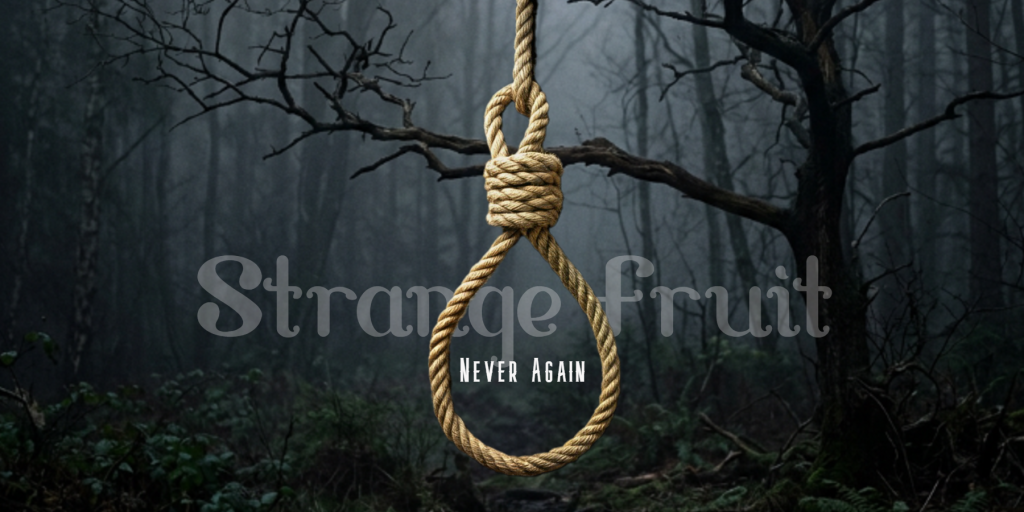
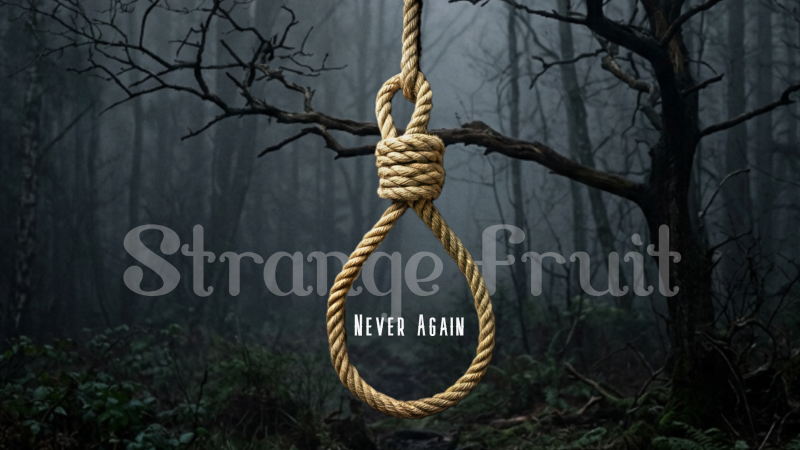
There are some images America doesn’t have the luxury of pretending aren’r controversial. Like a burning cross. A white hood. A Black body hanging from a tree.
For generations, that final image was not merely a method of murder. It was a distinct message. Left where people could see it because terror required an audience. That’s why, when another Black American is discovered hanging from a tree in 2026, many Black people don’t just experience the news as an isolated death. They experience it as an historical alarm.
For Black America, the sight of a Black body suspended from a tree branch is not just a death scene. It’s an echo of terror, a warning, and a reminder of bodies once left hanging beneath Southern trees while crowds gathered below them. So, when news of Black people being found from branches today, the question comes almost instinctively. Are we witnessing strange fruit growing again?
That question doesn’t automatically establish that any particular death was a lynching. There must be evidence to determine that. But neither can America’s history be erased from the way these deaths are perceived either. Because lately, there have been enough of them to make people profoundly uneasy. America’s history has created a degree of PTSD for many who either remember, or are simply reminded of the Sdouthern ghost of the past.
That’s why these are Patterns That Cannot Simply Be Dismissed!
On August 3, 2026, 29-year-old Tasia Fortune, a Black mother of four, was found hanging from a tree behind a vacant house in Jackson, Mississippi. Authorities have not announced an official cause or manner of death, and the investigation remained open. Mississippi Today reported that police had identified a person of interest being held on an unrelated matter, while Fortune’s family awaited answers.
Her mother has resisted assumptions that her daughter killed herself. Now suddenly America was looking at Mississippi again. A Black woman, a tree, a hanging body, and unanswered questions. That imagery carries an unbearable historical weight in a state whose soil has absorbed more than its share of racial blood.
Less than a year earlier, 21-year-old Demartravion “Trey” Reed was found hanging from a tree on the campus of Delta State University in Cleveland, Mississippi.\Rumors exploded almost immediately. Authorities later said the state medical examiner determined Reed’s death was suicide and reported no evidence of assault or foul play. It was revealed later that Reed’s girlfriend had received messages in which he threatened suicide. His family nevertheless pursued additional answers and an independent examination.
Millions of people saw the words Black student, Mississippi, hanging, and tree, and America’s past walked immediately into the present. That reaction wasn’t created by social media. America’ ‘s history created it.
Then Came Georgia. On February 18, 2026, 21-year-old Kyle Bassinga was found hanging from a tree in a wooded portion of Fair Oaks Park in Cobb County, Georgia. Police investigated and ultimately said evidence showed Bassinga was alone and that there was no indication of foul play. His family later issued a statement thanking investigators and asking for privacy.
Again, the official conclusion matters. But again, so does the historical reflex. Because before America asks Black people why they are suspicious, America might first ask itself why the sight of a Black person hanging from a tree has such a specific meaning.
Then came Tonea Nicole Miller inMiami, Another Black Woman and Another Tree. This 27-year-old Black woman was reported found hanging from a tree at Gwen Cherry Park in Miami on June 18, 2026. Authorities reportedly treated the death as an apparent suicide and said there was no indication of foul play, while questions and calls for additional transparency circulated online.
Once again a Black body, a tree, an official explanation, and a public struggling to reconcile the explanation with the image before them.
Perhaps one of the most disturbing reminders that this anxiety is not confined to Mississippi, Alabama or Georgia came from Wisconsin, which isn’t the deep south. On November 13, 2025, 39-year-old Torrance “Tory” Medley was found hanging from a tree at Brookfield Hills Golf Course outside Milwaukee. Police said the evidence pointed toward suicide, but his family wanted more information. The local NAACP joined calls for transparency.
This was Wisconsin. Not Mississippi. Not Alabama, and it wasn’t Louisiana. Because lynching was never exclusively Southern. The Equal Justice Initiative has documented hundreds of racial-terror lynchings outside the traditional South as well. In fact, the Equal Justice Initiative reminds us that Alabama gave America a case that still raises questions.
In September 2024, 39-year-old Dennoriss Richardson was found hanging inside an abandoned house in Colbert County, Alabama. Authorities initially classified his death as suicide. But there was an extraordinary complication. Richardson had been involved in a federal civil-rights lawsuit alleging abuse by local law enforcement. His family questioned the suicide determination.
The local sheriff ultimately requested FBI involvement, and two examinations did not produce identical conclusions: the state examination ruled suicide, while a privately commissioned examination could not definitively determine the manner of death. That doesn’ prove Richardson was lynched. But it demonstrates precisely why serious investigation, independent review where warranted, preservation of evidence and transparency are indispensable.
Even when suicide ss proven, history still enters the room. In February 2024, Trevonte Jamal Shubert-Helton, 29, was found hanging from a tree at a wildlife management area in northern Georgia. The Georgia Bureau of Investigation investigated the death and later announced that its findings and the medical examiner’s preliminary findings supported suicide.
And just weeks ago, on August 15, 2026, a 32-year-old Black man was found hanging from a tree in downtown Raleigh, North Carolina. Police publicly addressed the explosion of concern. Investigators said surveillance video showed him arriving alone carrying an electrical cord and that there was no evidence another person caused his death. Authorities concluded it was suicide, pending the medical examiner’s final process.
An interesting point of note in many of these cases is the final conclusion tends to point to death by suicide, but Black people historically aren’t known to commit suicide by hanging themselves from a tree. let’s face it, some Black Americans found hanging from trees have died by suicide. We must acknowledging that fact, but iy doesn’t erase America’s lynching history.
There Is Something America must understand. Black America didn’t invent this fear. White America taught it. For decades after slavery, hanging Black people from trees became one of America’s most recognizable instruments of racial terrorism. The Equal Justice Initiative has now documented nearly 6,500 racial-terror lynchings of Black people between 1865 and 1950, including almost 2,000 during Reconstruction alone.
These were not simply murders. They were performances of domination, while white mobs dragged Black people from homes and jail cells. Women were killed too. Children witnessed bodies dangling above crowds. The terror forced some BlackFamilies to flee entire counties.
While white people, sometimes by the thousands, gathered in festivity to watch the public execution of a human being. Then many photographs were tgaken, and postcards were made with the horrific imagery of human carnage, as human remains were sometimes treated as souvenirs.
The objective has always extended beyond the killing one of just one Black person. It was to make every other Black person understand what could happen to them. That’s American terrorism in it;s original form.
That’s why every investigation involving this uniquely horrifying imagery should therefore be conducted with extraordinary professionalism and transparency. Each suspicious death of a Black person hanging from a tree, whether it’s in America’s troubled south or in the mid-west, the conscious of our nation will be stired until definitive evidence conforms that the ghost of our past hasn’t returned.
Until every suspicious death receives the transparency, scrutiny and seriousness it deserves, nobody should be surprised when Black America looks toward the branches and wonders whether the bitter crop has returned. Because some fruit carries memory. Some trees have witnessed too muchand are burdened with the weight of souls lost. America knows exactly why we still call it
David B. Adams is a journalist, crime writer, and founder of The People's Champion, a platform built on truth, justice, and advocacy for the overlooked. For over a decade, Adams has investigated wrongful convictions, missing and exploited children, homelessness, and the political forces that shape marginalized communities' lives.
What sets his work apart is a refusal to sensationalize. Adams treats crime reporting as human storytelling — pushing past headlines to examine the systemic failures in law enforcement, the courts, and government that so often go unexamined. He's built a reputation among activists and advocates for combining deep research, personal narrative, and unflinching commentary.
The People's Champion began as a personal outlet and has grown into a respected independent voice in crime and justice journalism, read by audiences nationwide who care about accountability and the people too often left out of the story.